Gate.io — live memecoin market data and signal coverage
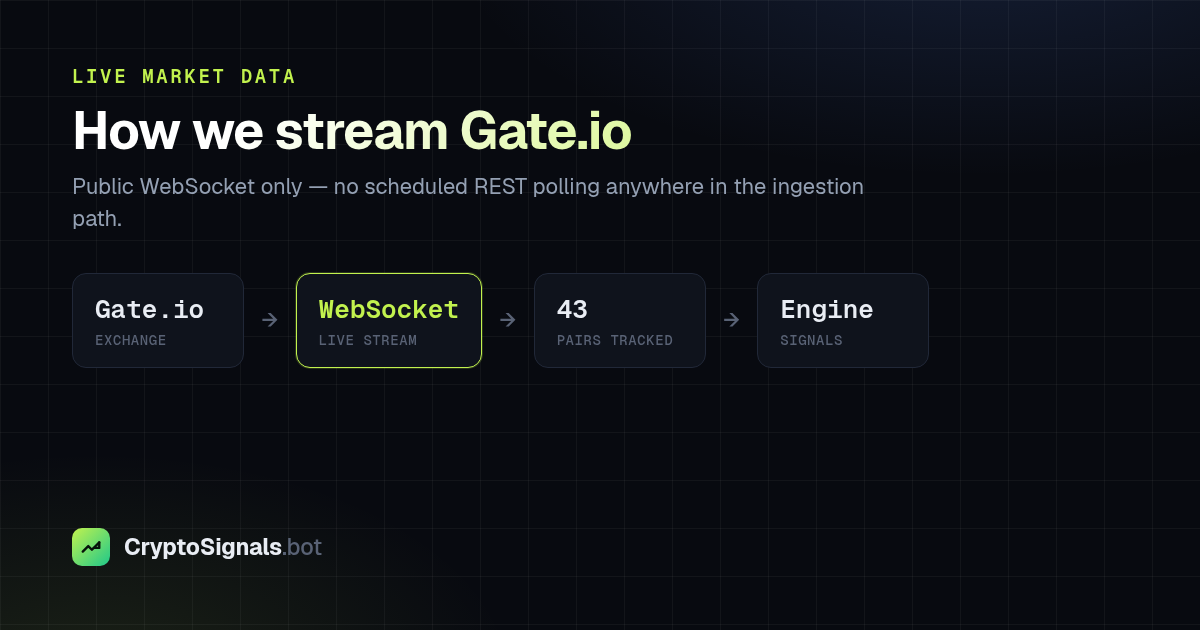
Our memecoin venue: 43 pairs streamed live over WebSocket, scored across five timeframes, simulated never executed.
Gate.io holds a very specific slot in the CryptoSignals.bot exchange lineup: it is our memecoin venue. Of the 43 pairs we stream from it, every single one is a memecoin. There are no majors on this roster at all — no Bitcoin pair, no Ethereum pair, nothing you would find on a blue-chip watchlist.
That is a deliberate design decision rather than a gap in coverage, and the reasoning is worth setting out, because it is the single thing that makes the gate io crypto exchange connection different from every other feed we run. Everything below describes what we do with public Gate.io market data: we stream candles over WebSocket, compute indicators across five timeframes, and run simulated campaigns against them. We place no orders, hold no trading keys, and have no affiliation with the exchange.
43trading pairs tracked
43memecoin pairs streamed
5timeframes computed
WSlive stream, no polling
Why Gate.io is our memecoin venue
We run eight exchange connections, and several of them carry the same majors. Bitcoin against the dollar exists on all of them, and the candles are, most of the time, nearly identical. Streaming the same asset from an eighth book adds cost and adds almost no information — the eighth chart tells you what the first seven already said.
The long tail behaves in the opposite way. Smaller and newer tokens are not uniformly listed or uniformly liquid, and where they trade genuinely changes what their chart looks like. A venue carrying a wide spread of that cohort is worth a dedicated connection in a way another Bitcoin feed is not. That is the job Gate.io does for us.
So when a reader searches for the Gate.io exchange and lands here, the honest framing is this: to CryptoSignals.bot, Gate.io is a data source for one asset class. We are not resellers, partners or affiliates. We read a public market feed that requires no account and no key, compute indicators on it, and show you the result. Nothing on this page is an endorsement of trading anywhere, on this venue or any other.
Coins we track on Gate.io
We currently stream 43 trading pairs from Gate.io. These are the ones our signal engine watches — updated from the live roster, not a static list.
DOGEDOGE_USDT
SHIBSHIB_USDT
PEPEPEPE_USDT
BONKBONK_USDT
WIFWIF_USDT
ACTACT_USDT
AIDOGEAIDOGE_USDT
BABYDOGEBABYDOGE_USDT
BANANABANANA_USDT
BOMEBOME_USDT
BRETTBRETT_USDT
CATICATI_USDT
CHILLGUYCHILLGUY_USDT
DEGENDEGEN_USDT
DOGSDOGS_USDT
ELONELON_USDT
FARTCOINFARTCOIN_USDT
FLOKIFLOKI_USDT
GIGAGIGA_USDT
GOATGOAT_USDT
HMSTRHMSTR_USDT
LADYSLADYS_USDT
LUNCLUNC_USDT
MELANIAMELANIA_USDT
and 19 more pairs tracked on this exchange
The 43-pair memecoin roster
The coin grid above is not hand-maintained copy. It is read from our live roster every time this page is requested, so it shows what the engine is genuinely subscribed to at this moment rather than what somebody typed into a file last quarter. Pairs that stop trading drop out on their own instead of lingering as dead entries.
At the time of writing that roster spans the familiar names — DOGE, SHIB, PEPE, BONK, WIF and FLOKI — alongside a much wider cohort: TRUMP, BOME, PENGU, PNUT, PUMP, TOSHI, TURBO, ACT, BANANA, CATI, DEGEN, DOGS, GOAT and HMSTR among them, out to 43 pairs in total.
We treat memecoins as a distinct asset class rather than as small altcoins, and that distinction runs all the way down into the engine. Indicator thresholds calibrated on Bitcoin fire more or less continuously against price action that can move thirty percent on a single social-media post. Volatility bands sized for a deep book are meaningless against a thin one. So memecoins get their own tuning, their own thresholds, and their own statistics — and they are reported separately from majors, so a strong week on the memecoin roster never quietly inflates the numbers you see for established assets. That separation cuts both ways, and it is the point: it keeps memecoin results honest and major-pair results uncontaminated.
How we connect: WebSocket only, no REST polling
Our market-data rule is strict and unusual enough to state plainly: all market data arrives over WebSocket. There is no scheduled REST polling anywhere in the ingestion path. A single REST call is permitted once, run by an administrator, to seed the instrument list when a venue is first brought online — never on a timer afterwards.
Polling hands you a snapshot from whenever your timer happened to fire; a stream hands you every candle as the exchange publishes it. On a memecoin roster that difference is not academic — arriving forty seconds after a 5-minute bar closes is the difference between a signal and a souvenir.
The connection is supervised rather than trusted. It reconnects with exponential backoff, re-subscribes deliberately instead of assuming a batch of subscriptions succeeded, and then verifies that every symbol it asked for is actually delivering data. That last check sounds pedantic until you meet a venue that accepts a subscription, acknowledges it, reports no error and then streams nothing at all. We have met one, and the check exists because of it.
Per-venue detail matters too. Gate.io timestamps its candles in seconds where most exchanges use milliseconds — a one-character assumption that would silently shift every bar by a factor of a thousand. Each adapter is written against the venue it actually talks to, not against an idealised average of all of them.
Timeframes and what the signal engine computes
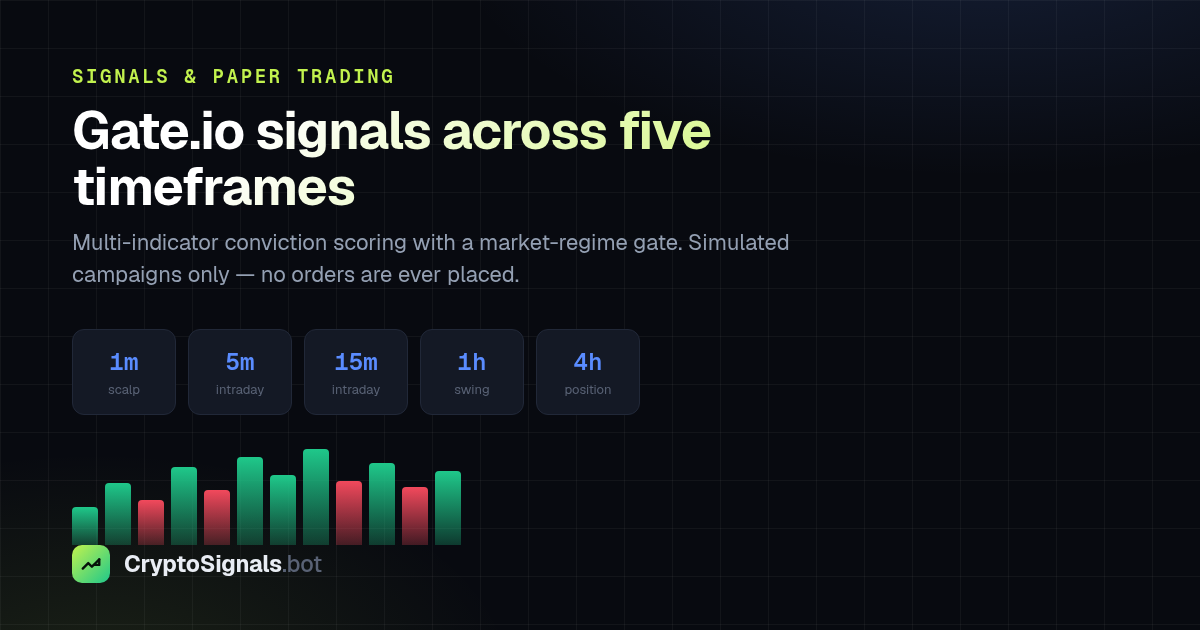
Every pair we track on Gate.io is computed across five timeframes: 1 minute, 5 minutes, 15 minutes, 1 hour and 4 hours. That ladder is identical on every exchange we support, which is what lets a signal mean the same thing regardless of which venue produced it.
On top of those candles the engine runs a multi-indicator model — trend, momentum, volatility and volume components — and combines them into a conviction score rather than firing on any single crossover. One moving-average cross is noise. A cross that agrees with momentum, with volume and with the prevailing market regime is something worth surfacing, and the score tells you which of the two you are looking at.
Before any signal is emitted it also passes a market-regime gate. The engine first asks what kind of market it is looking at, because a breakout model that performs in a trending market produces a steady drip of losses in a choppy one. Signals carry the regime they were produced under, so they can be judged in context instead of as context-free arrows on a chart. On a memecoin-only venue that gate does a lot of work: this is exactly the corner of the market where regime shifts arrive fastest and hardest.
Gate.io reviews, US customers, and what we can honestly tell you
Two of the most common searches around this venue are for a Gate.io review and for whether it serves United States customers. Both deserve a straight answer, and in our case the straight answer is that they are outside what we are qualified to speak on.
CryptoSignals.bot is not a review site. We do not rate, rank or score exchanges, and we hold no referral relationship with any venue we stream — a page that scores an exchange while earning a commission on sign-ups is telling you more about its own incentives than about the exchange. What we publish about Gate.io is what our own connection to it observes.
Eligibility is the same story. Which jurisdictions an exchange serves and what verification it requires are set by the exchange and its regulators, not by us, and those rules change. The exchange itself is the only authoritative source on whether it is available where you live — its current terms beat a third-party page written at some unknown date.
What we can say plainly is that none of it changes what you get here. Our signals are computed from public market data and require no account on Gate.io or anywhere else. A reader who cannot use the venue still sees the same candles, the same conviction scores and the same simulated results as anyone else, because we never touch an account to produce them.
Paper trading and alerts on Gate.io pairs
Any signal on a Gate.io pair can drive a simulated campaign. You define the rules — which pairs, which timeframes, what conviction threshold, what position sizing — and the engine runs them against live market data, recording entries, exits and a running tally of gains and losses exactly as though the orders had been placed.
Nothing is executed. This is the whole of what CryptoSignals.bot is: a signal simulator and an alerting tool. No order ever leaves the platform, because the platform has no mechanism to send one and no key that would be accepted if it tried. You can watch a set of rules behave in live memecoin conditions for weeks before forming any opinion about it, with no capital exposed at any point.
Alerts can be delivered when a campaign fires, so following a fast roster does not mean sitting in front of a chart all day. What you do with an alert once it arrives is entirely your own decision.
Gate.io — frequently asked questions
Does CryptoSignals.bot trade on Gate.io for me?
No. We read public market data only. We hold no Gate.io API keys with trading permission and the platform places no orders. Signals and simulated campaigns are informational, and every actual trading decision stays with you.
Why does the Gate.io roster contain no Bitcoin or Ethereum?
By design. Gate.io is our memecoin venue, and majors are already covered in depth by the other exchanges we stream. Duplicating the same major pairs across another book would add cost and almost no new information.
Do I need a Gate.io account to use CryptoSignals.bot?
No. We stream the public market feed rather than any account data, so signals, alerts and paper trading on Gate.io pairs all work without an account on the exchange.
Is this a Gate.io review, and are you affiliated with the exchange?
Neither. We do not review, rate or rank exchanges, and we have no affiliation, partnership or referral arrangement with Gate.io. It is a market-data source for one asset class on our platform, nothing more.
Can United States customers use Gate.io?
We are not in a position to answer that. Which jurisdictions a venue serves and what verification it requires are set by the exchange and can change, so its own current terms are the only reliable source. It does not affect our coverage either way, since our data is public and needs no account.
How are memecoin signals different from signals on major pairs?
They are tuned separately and reported separately. Thresholds calibrated on deep, slow markets misfire constantly on memecoin volatility, so the memecoin cohort gets its own calibration and its own statistics rather than being blended into major-pair results.
Is this financial advice?
No. CryptoSignals.bot is a signal simulator and alerting tool. Nothing on this page or in the product is a recommendation to buy or sell any asset. Crypto trading carries substantial risk, including the total loss of the amount involved, and memecoins are among the most volatile instruments in that market.