OKX crypto exchange — live market data and signal coverage
A global spot venue with a broad altcoin and memecoin roster, streamed live into the CryptoSignals engine over WebSocket.
OKX is a global cryptocurrency exchange whose spot market spans the majors, a long list of established altcoins and one of the wider memecoin tails we cover anywhere. CryptoSignals.bot connects to its public market-data feed, streams candles live, and computes signals from them exactly as it does on every other venue we support.
This page is not a review and not a referral pitch. It is a plain description of our coverage: which pairs we watch on the OKX crypto exchange, how the connection is built, what the engine does with the data, and — just as importantly — what we deliberately do not do. We read public prices. We never place an order.
50trading pairs tracked
5timeframes computed
WSlive stream, no polling
What is OKX, and why we stream it
Searches for what OKX is usually return a marketing page or an affiliate review scored out of ten. Neither helps if the question you actually have is whether the venue produces data worth reading, so here is the answer from a data engineer's seat.
OKX is a centralized exchange running a spot order book alongside a wider product family — a self-custody wallet and a DEX aggregator among them — under the same brand. Only the first of those matters to us. We connect to the public spot feed and nothing else; every account-side product is outside our scope entirely.
What makes the venue useful to a signal engine is the shape of its listing set rather than any headline about size. OKX carries the assets a technical model behaves well on — Bitcoin, Ethereum, Solana, XRP and the established layer-one and infrastructure names — alongside a genuinely deep memecoin tail. One connection therefore feeds two very different kinds of market into the same engine, which is exactly the comparison our users want.
To be unambiguous about the relationship: we are not affiliated with OKX, and this page is not an endorsement of trading there. OKX is a data source to us — public prices in, indicators out.
Coins we track on OKX
We currently stream 50 trading pairs from OKX. These are the ones our signal engine watches — updated from the live roster, not a static list.
BTCBTC-USDT
ETHETH-USDT
SOLSOL-USDT
XRPXRP-USDT
DOGEDOGE-USDT
ADAADA-USDT
TRXTRX-USDT
AVAXAVAX-USDT
LINKLINK-USDT
DOTDOT-USDT
LTCLTC-USDT
SHIBSHIB-USDT
UNIUNI-USDT
ATOMATOM-USDT
XLMXLM-USDT
NEARNEAR-USDT
ALGOALGO-USDT
FILFIL-USDT
ICPICP-USDT
HBARHBAR-USDT
APTAPT-USDT
ARBARB-USDT
OPOP-USDT
SUISUI-USDT
and 26 more pairs tracked on this exchange
How we connect: WebSocket only, no REST polling
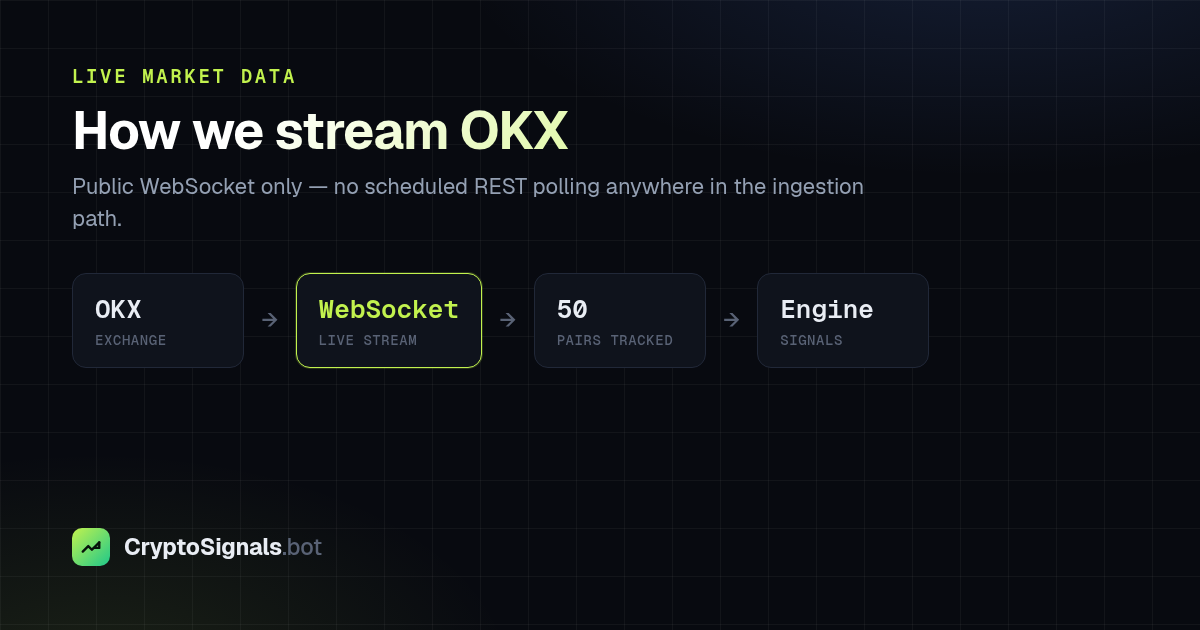
Our ingestion rule is strict, and it is worth stating plainly because it is unusual: all market data arrives over WebSocket. There is no scheduled REST polling anywhere in the path. Exactly one REST call is permitted, run once by an administrator, to read the instrument list when an exchange is first seeded — and never on a timer afterwards.
The reason is data quality rather than etiquette. Polling hands you whatever the book looked like at the instant your timer fired; a stream hands you every candle as the exchange publishes its close. When a rule depends on the close of a five-minute bar, learning about it forty seconds late is the difference between a signal and a piece of history.
The connection is supervised rather than trusted. It reconnects with exponential backoff, it re-subscribes deliberately instead of assuming a batch request succeeded, and it verifies that every symbol it asked for is genuinely delivering candles. That last check sounds pedantic until you meet a venue that accepts a subscription, acknowledges it, reports no error and then quietly streams nothing. We have. The check runs against OKX like everywhere else.
People occasionally ask about the OKX API in this context. The public market-data stream needs no key at all, which is the point: there is a hard wall between reading prices and touching an account, and we stay firmly on the reading side of it.
Timeframes and what the signal engine computes
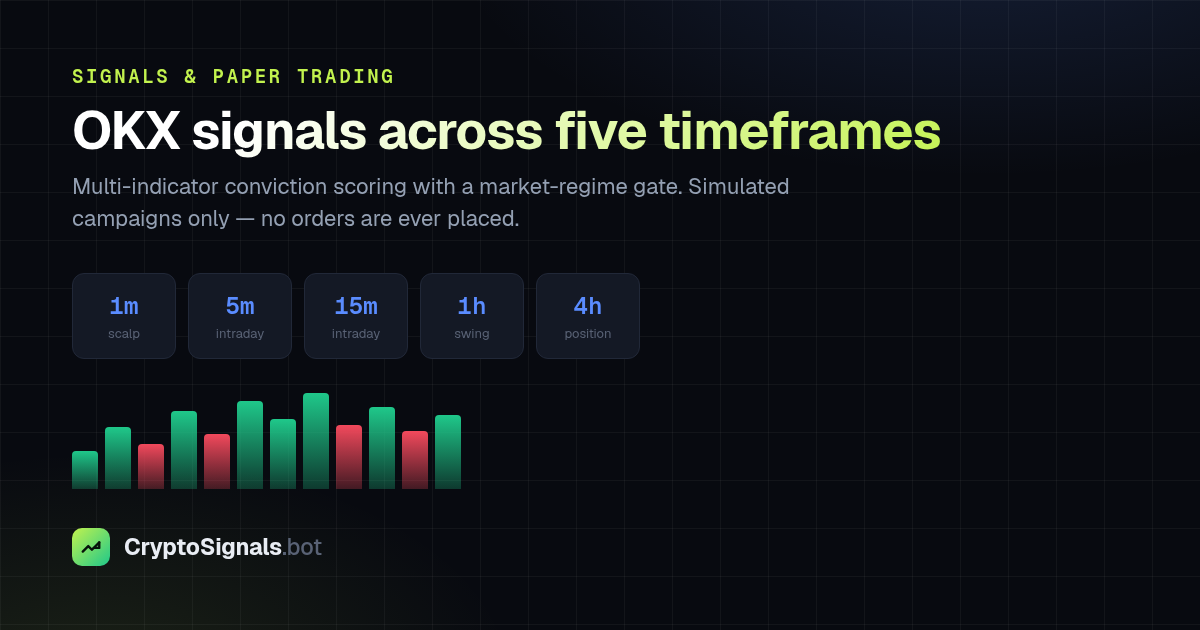
Every OKX pair we track is computed across five timeframes: 1 minute, 5 minutes, 15 minutes, 1 hour and 4 hours. That ladder is identical on every exchange we support, deliberately, so a signal carries the same meaning whichever venue produced it and cross-venue comparisons stay honest.
On top of those candles the engine runs a multi-indicator model covering trend, momentum, volatility and volume, then combines the components into a conviction score. It does not fire on a single crossover. A moving-average cross on its own is noise; a cross that agrees with momentum, with volume behaviour and with the prevailing market regime is worth putting in front of someone.
That last clause is a real gate, not a figure of speech. Before any signal is emitted the engine classifies the market it is looking at, because a breakout rule that reads beautifully in a trending market produces a steady drip of losses in a choppy one. Signals are labelled with the regime they were produced under, so they can be judged in context rather than as a bare score.
None of it is a prediction. The engine describes what the indicators are doing on OKX candles right now; it does not know what happens next, and it is not built to pretend otherwise.
Majors, altcoins and memecoins on OKX
The coin grid above is not a hand-written list. It is read from our live roster every time this page loads, so it reflects what the engine is genuinely watching on OKX at this moment rather than what someone typed into a template last quarter.
At present that roster runs to fifty pairs, and it splits roughly in half. On the majors and established-altcoin side we track BTC, ETH, SOL, XRP, ADA, TRX, AVAX, LINK, DOT, LTC, UNI, ATOM, XLM, NEAR, ALGO and FIL. These are the markets where technical models behave most predictably, and they are the ones we lean on when validating a change to the engine.
The other side is the memecoin cohort — twenty-three of them, including DOGE, SHIB, PEPE, BONK, FLOKI, TRUMP, WIF, BOME, PENGU, PNUT, PUMP, TOSHI, TURBO, ACT, BANANA, CATI, DEGEN, DOGS, GOAT and HMSTR. We treat memecoins as a distinct asset class rather than as small altcoins, because statistically they are one. A memecoin can move violently inside a single hour on one social-media post; indicator thresholds calibrated on Bitcoin fire almost continuously against that kind of price action. So memecoins get their own tuning, and their results are reported separately from the majors instead of being averaged into one flattering number.
The spot order book, not the OKX wallet or DEX
Two of the most common OKX searches are for the OKX DEX and the OKX wallet, so it is worth drawing the boundary clearly. Those are self-custody and on-chain products. What we read is the centralized spot order book, and only that.
The distinction is data integrity, not pedantry. An on-chain aggregator and a centralized book are different markets with different prices, different depth and different failure modes. Blending them would produce candles matching nothing a user could see on their own screen, and a signal computed from a fiction is worse than no signal. So every venue is streamed on its own connection, with its own roster, and its signals come strictly from that venue's own candles — the same rule that makes Binance and Binance.US two separate exchanges here, and Gate.io a memecoin-only one.
It also means you never connect a wallet to us and never grant us any on-chain permission. There is nothing to sign.
Paper trading and alerts on OKX pairs
Any signal on an OKX pair can drive a simulated campaign. You set the rules — pairs, timeframes, conviction threshold, position sizing — and the engine runs them against live market data, recording entries, exits and a running tally of gains and losses as though the orders had been placed.
Nothing is executed. That is the whole shape of the product: CryptoSignals.bot is a signal simulator and an alerting tool. You can watch a set of rules behave in real OKX conditions for weeks, across both the majors and the memecoin side of the roster, with no capital at risk at any point — there is no account to put capital in.
Alerts can be delivered when a campaign fires, so you are not tied to a chart. What you do with an alert afterwards is entirely your own decision, made on the exchange, under your own judgement.
OKX — frequently asked questions
Does CryptoSignals.bot trade on OKX for me?
No. We read public market data only. We hold no OKX API keys with trading permission, and the platform places no orders of any kind. Signals and simulated campaigns are informational.
Do I need an OKX account to use CryptoSignals.bot?
No. Signals and paper trading on OKX pairs work without any exchange account, because we stream the public market feed rather than anything belonging to your account.
Which OKX coins does the engine track?
Fifty pairs at present, generated live in the grid above: roughly half majors and established altcoins such as BTC, ETH, SOL and XRP, the rest a memecoin cohort of twenty-three. A pair that stops trading is retired automatically rather than lingering as a dead row.
Do you use the OKX DEX or the OKX wallet?
No. We stream the centralized spot order book only. We do not connect to on-chain products, you never link a wallet to us, and we never ask you to sign anything.
Is this an OKX review, or are you affiliated with OKX?
Neither. We are not affiliated with OKX and this page is not a review or a recommendation of the venue. It describes the market data we read there and what our engine does with it.
How fast is the data?
It arrives over a live WebSocket stream as the exchange publishes each candle. We do not poll on a timer, so there is no fixed refresh interval between a bar closing and the engine seeing it.
Is this financial advice?
No. CryptoSignals.bot is a signal simulator and alerting tool. Nothing on this page or in the product is a recommendation to buy or sell any asset, and no result is promised or implied. Crypto trading carries substantial risk, including total loss of capital.